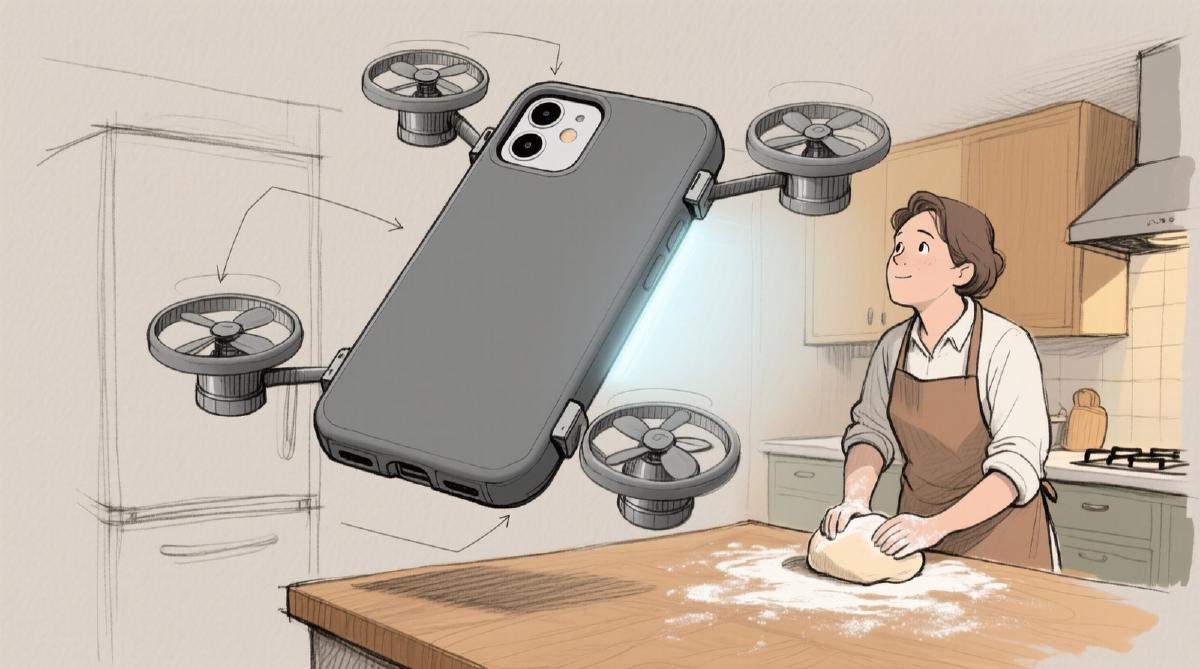

Let me say up front that I have not built this, and probably will not any time soon. This article just takes an idea I have carried for a while, writes it out properly with sketches and a spec, and puts a date on it, because if this category of product does take off a few years from now, this page can at least show the idea was fully described on September 1, 2026. Anyone is welcome to build it, and if you do, I would simply like to hear about it.
The idea comes from the first quarter of this year, when I was studying ESP32 development. That hobby stopped early, because it kept requiring new parts and took up too much space at home, but one item on the list stayed with me: integrating an iPhone case and a quadcopter into a single object.
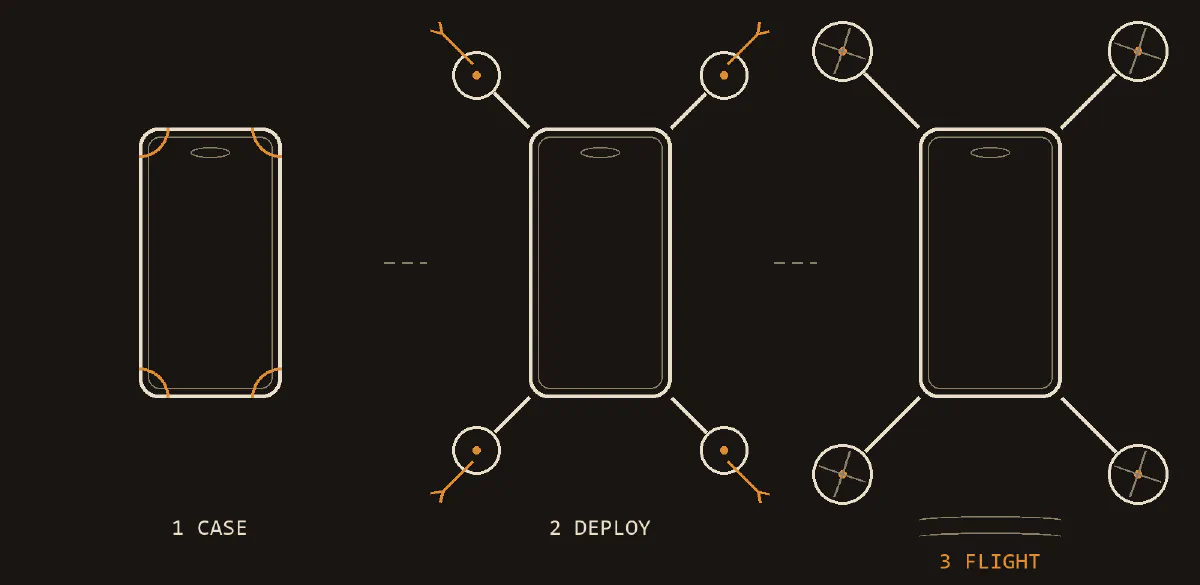
The concept in one sentence#
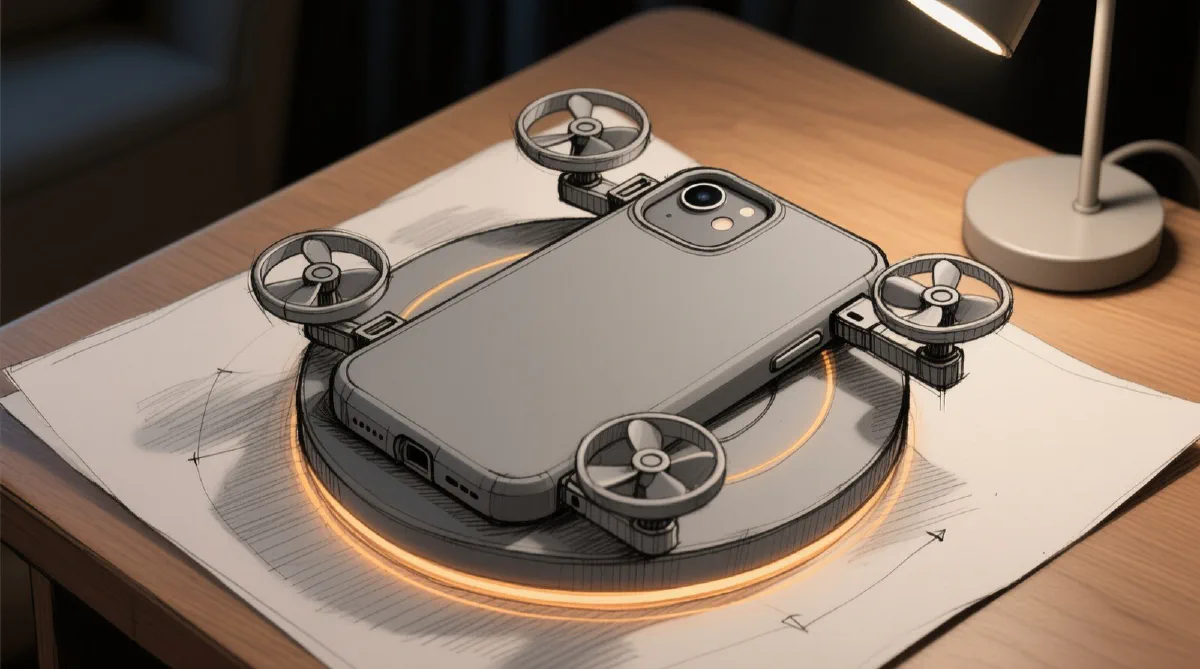
Most of the time it is just a phone case; when needed, four folding rotor arms deploy and the case takes off, carrying your iPhone with it.
The point is that the case itself is the airframe, rather than a tiny drone that perches on your case. The iPhone is its payload, screen, compute, and part of its sensor suite, so together they form a drone you already carry every day.
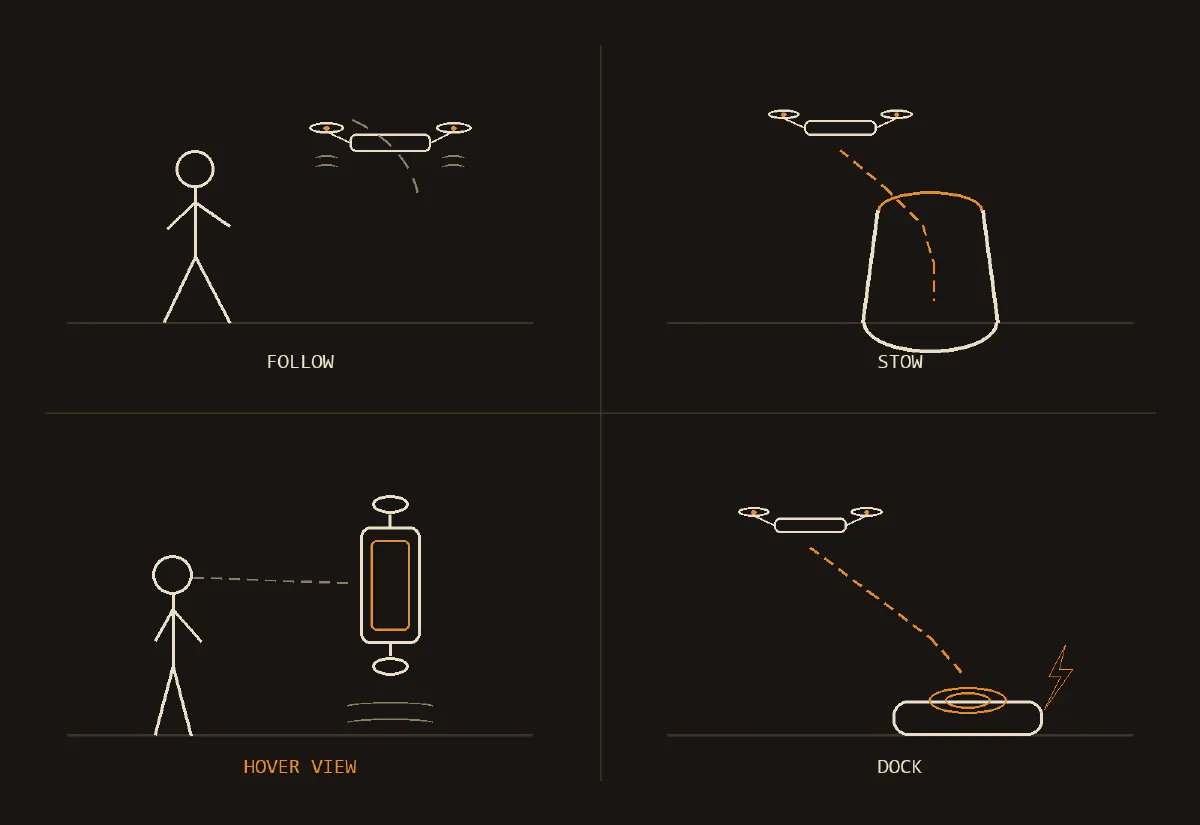
The four core behaviors#
- Follow-cam: it watches you through its camera and follows. Walking, cycling, or chasing a toddler, it trails behind and above, and your hands are free.
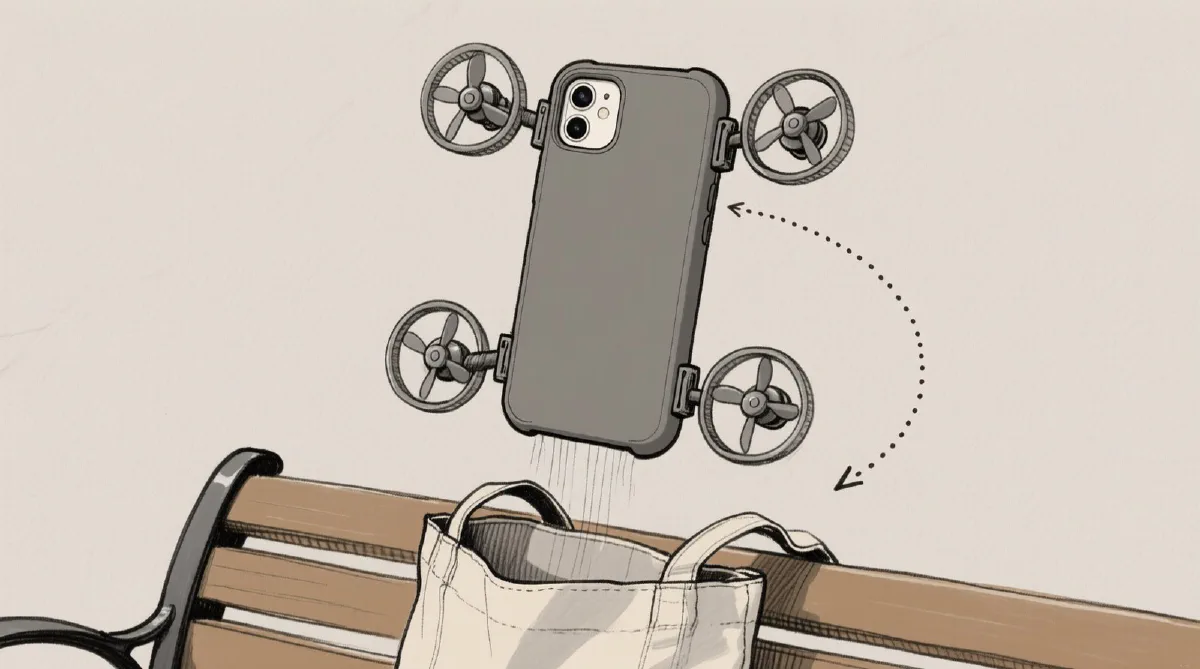
- Self-stowing: no catching it out of the air. When the shot is done it flies itself into your open bag, folds its arms, powers down, and becomes a case again.
- Hover display: it hovers about 40 to 60 cm in front of your eyes so you can watch the screen without using your hands, for example cooking from a recipe, following a repair video under the sink, or watching a show lying down. The screen is the phone’s own screen, which is exactly why the case has to carry the phone.
- Return-to-dock: on low battery or end of task, it flies back to its wireless charging dock, self-aligns on MagSafe magnets, and lands charging.
Draft spec (v0, on paper)#
Every number below is an estimate, and none of them has been validated.
| Item | Draft | Notes |
|---|---|---|
| Form factor | Full-wrap case + four folding rotor arms | Target folded thickness within 15 mm including arms |
| Empty weight | Within 180 g (case + motors + battery + guards) | A Pro-class iPhone is around 200 g, so all-up weight lands around 380 to 400 g |
| Rotors | Quad, ducted guards mandatory | Because face-level hovering is a core scenario, open props are not acceptable |
| Locating the user | UWB primary, vision secondary | iPhones already ship UWB silicon, so following the owner is nearly off the shelf; the camera handles gestures and obstacles |
| Locating the ground | Downward ToF + optical flow | Indoors is the primary battlefield, so no GNSS dependence |
| Power | Independent battery in the case, never drains the phone | Target 8 to 12 minutes of hover, MagSafe-aligned recharging |
| Control | The phone itself is the flight computer | The case keeps only a minimal IMU and ESC real-time loop, planning runs on the iPhone |
| Interface | Gestures + voice + watch | Because the phone is in the air, controlling it from your phone is impossible, so these three are what remains |
| Regulation | Taiwan requires registration above 250 g | All-up weight will exceed it, so outdoor use requires registration; flying at home is outside that rule |
Why write this in 2026#
Because the parts have mostly arrived. Sub-150 g selfie drones are commodity hardware now (the DJI Neo class, 135 g), so micro rotor systems have enough power density; UWB is built into the phone, so precisely following its owner no longer needs an external beacon; and the MagSafe ecosystem is mature, so a self-aligning magnetic charge dock is an off-the-shelf part. The compute, the cameras, and the screen are already inside the case, carried there by the phone, so almost the only new thing this product needs is the flying case itself.
Honest unsolved problems#
In order of severity:
- A crash is also a phone crash. The payload is the most expensive object most people carry, so the cost of every failure mode is amplified. Guards save the props, not a three-meter free fall. A possible mitigation is a hard altitude ceiling (say 2.5 m) plus redundant baro and ToF, though “never falls” does not exist in physics.
- Noise. Hovering 50 cm from your face points four rotors’ sound pressure straight at you, and the binge-watching scenario has almost zero noise tolerance. How much ducts and large slow props can suppress probably decides whether core behavior #3 exists at all.
- The daily tax of thickness and weight. A 15 mm, 180 g case is a cost you pay every day, in exchange for a benefit you use occasionally, and whether that trade clears can only be learned by building it.
- Face-proximity safety. Beyond ducts and guards, it likely needs enforced standoff, for example auto-retreat whenever it closes within 30 cm of a face.
- Endurance. 8 to 12 minutes of hover is not enough for a movie, and probably enough for one tracking shot or one repair video. So it is closer to a moments tool than a persistent platform, and the spec is only honest if it admits that.
Priority statement#
This article is a concept disclosure published on 2026-09-01; the idea dates to the author’s ESP32 period in the first quarter of 2026. The combination described above, case-as-airframe, UWB follow, self-stowing, eye-level hands-free hover display, and MagSafe return-to-dock charging, is hereby publicly described. Free to use, and if you build it, tell me.
This is an independent publication and has not been authorized, sponsored, or otherwise approved by Apple Inc. iPhone and MagSafe are trademarks of Apple Inc., registered in the U.S. and other countries and regions. DJI and DJI Neo are trademarks of SZ DJI Technology Co., Ltd. ESP32 is a trademark of Espressif Systems (Shanghai) Co., Ltd. All marks are used here only to describe compatibility, market context, and personal experience, and imply no affiliation.