
With the same tool, some people save a great deal of time, while others try a few times and find it not much use. A gap that large is usually not a technical matter; it has to do with the work environment.
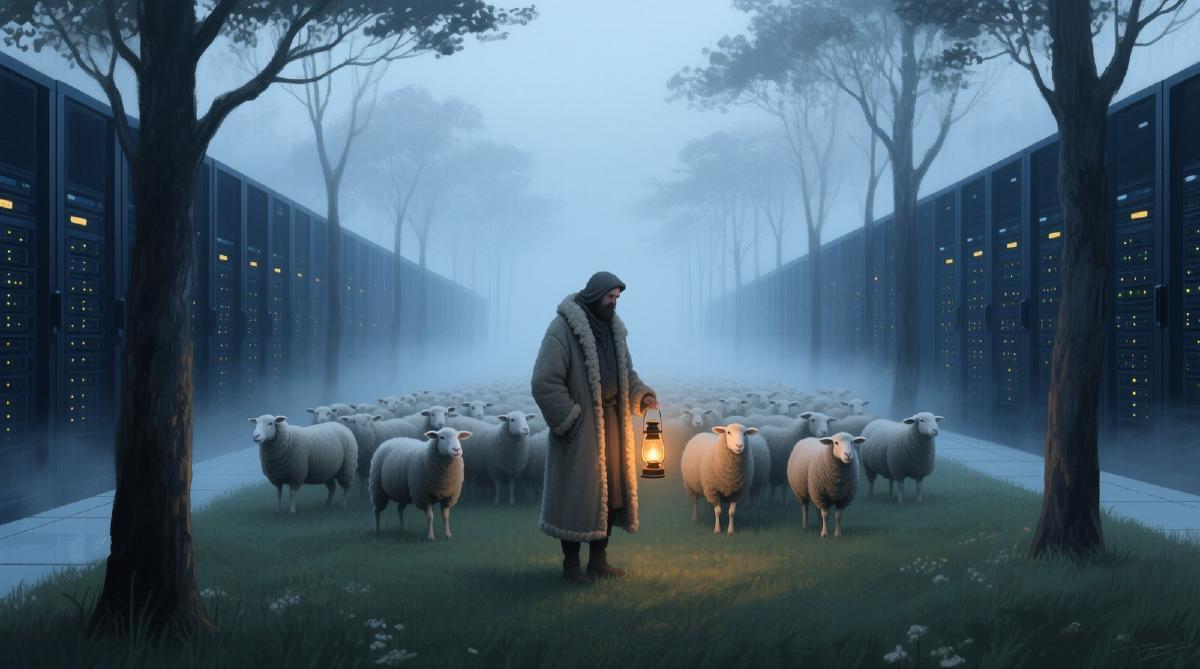
My job is something like a cloud-era shepherd: I keep all the sheep (machines) in the server room and make sure the servers and related equipment keep running. Chores of this kind can be compressed enormously, and that depends on the conditions below, most of which have nothing to do with “how good you are at AI”.
The six conditions#
- In theory every step of the work can be optimised; it was not done before because optimisation itself has a cost.
- Corresponding to the first, AI agents push the cost of optimising down to almost nothing.
- If you have worked in a very formal, rigorous, finely divided environment, you know that the great majority of steps can be optimised or abstracted, and you also know which level to abstract to, and the latter is the harder part.
- In most cases you can work independently and judge for yourself; you only have to review the AI’s output yourself, with no sign-off to send up.
- Following on, the time saved has a chance of being at your own disposal. This decides whether you are willing to keep optimising; if the saved time is immediately stuffed with new work, the flywheel cannot turn.
- The objects you work on can, to some degree, be virtualised and treated like code (the term is IaC, Infrastructure as Code1).
Turned around, these six are also the reasons AI agents are limited in some work environments.
If every step needs a manager’s sign-off, your output cannot be reviewed by you, your saved time is filled at once, and what you work on is the physical world rather than the digital one, then it is not that you cannot use AI; the environment’s leverage ratio was low to begin with.
Self-assessment#
- 1
- 2
- 3
- 4
- 5
- 6
Condition 3 is usually the missing one#
The first two are given by the era, and 4, 5 and 6 by the environment; those three you mostly cannot change. The one you can actually practise is the third, knowing which level to abstract to.
It sounds mystical but it is quite concrete. The same need, “check a batch of machines every day”, can be abstracted into a script, a schedule, a spec an agent can read, or a set of steps anyone taking over could re-run. Abstract too shallow and the agent cannot help; abstract too deep and you spend three months building a framework nobody uses.
That judgement cannot currently be outsourced to AI. It is condition 3, and it is why the same tool differs many times over in different hands.
If you look at the self-assessment and find it is condition 3 you are stuck on, knowing there is something to automate but not where to cut, that is exactly what I do.
Fixed scope, delivered once built, no maintenance lock-in →
IaC (Infrastructure as Code): managing the configuration of servers, networks, storage and other infrastructure as code rather than by clicking through by hand. The benefits are version control, reproducibility and reviewability, and because it is text, AI can read and write it directly. ↩︎